
Post-quantum roundup | Week 7, 2026 - Ethereum progress on PQC
A weekly roundup that prepares technologists for the quantum computing revolution and the post-quantum world

The Post-Quantum Weekly Roundup prepares technologists for the quantum computing revolution and post-quantum world.
After careful reflection, I don’t want this weekly newsletter to be only a list of links. It will now include what I do best—explanations of concepts in an intuitive, practical way. It features a Definition of the Week section, where I explain a valuable term in quantum computing and information science. This edition also includes an Academic Paper of the Week, though I’m not quite sure how it will evolve. Explaining an academic paper in a paragraph may not do it justice, and anything more than an abstract deserves its own separate article.
Definition of the Week
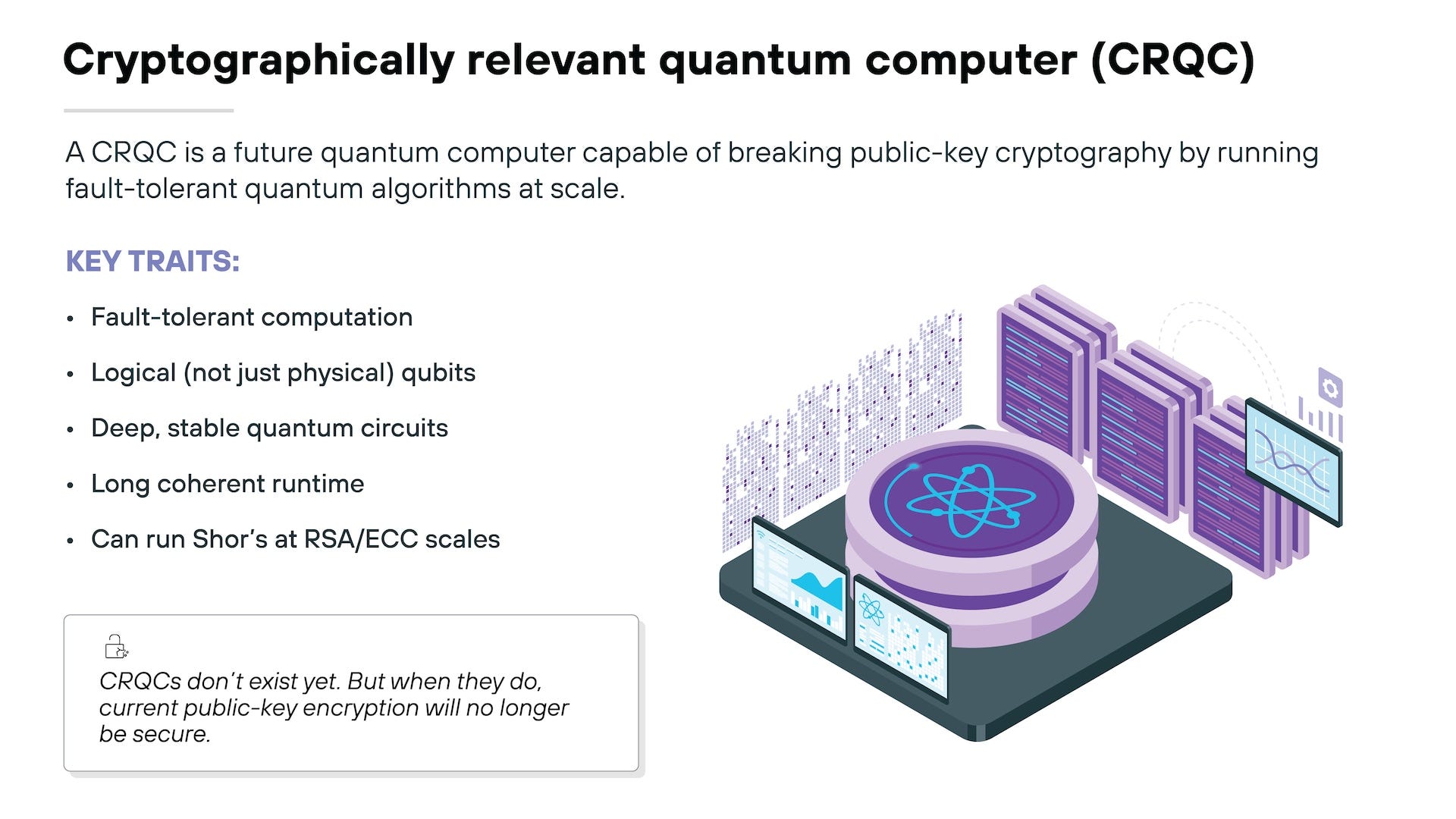
A Cryptographically Relevant Quantum Computer (CRQC) is a quantum computer capable of breaking widely used public-key encryption at scale. The release is predicted to be between mid-2030 and 2040.
This term, though old, appeared in a short blog post published by Google this week, calling on businesses and policymakers to prepare for when quantum computers are productized, cost-effective, and practical enough for widespread use, or for the release of a CRQC.
Academic Paper of the Week
Kim, H., Jang, K., Wang, S., Baksi, A., Song, G., Seo, H., & Chattopadhyay, A. (2026). New quantum circuits for ECDLP: Breaking prime elliptic curve cryptography in minutes (IACR ePrint Archive, Report 2026/106). https://eprint.iacr.org/2026/106
New research shows that elliptic curve cryptography, the main cryptographic scheme that powers mobile phones, blockchains, SSL/TLS web certificates, and more, can be broken in either 34 minutes with 19.1 million qubits or 96 minutes with 6.9 million qubits, using optimization strategies.
However, the paper is theoretical because the largest quantum computer has 6,100 qubits, whereas no one currently has 6.9 million qubits.
Education
50 teams of Qiskit advocates (think of them as ambassadors to the Qiskit programming language) presented quantum computing projects that they’ve worked on through the Qiskit Advocate Mentorship Program. Most of the projects are quite theoretical or academic, but they all offer an overview of the academic pitch and solution, which might be useful. Watch the replay.
Every Wednesday, the Unitary Foundation invites an academic to give a virtual talk on their recent research in quantum mechanics and/or computing. Join Quantum Wednesdays via their Discord. This week’s Quantum Wednesday is still being decided, but previous weeks included topics such as applications of quantum algorithms and quantum error correction (which addresses the many errors that occur in quantum computing).
Practical Introduction to Quantum-Safe Cryptography, a free online course by IBM
News
India has broken ground on its “Quantum Valley” in Amaravati, Andhra Pradesh, 1000km east of Mumbai. It will host India’s first 133-qubit quantum computer.
P.S. Here’s a photo of me at my cousin’s wedding this week in Jaipur, Rajasthan, a popular wedding destination in India. I also attended another family wedding in Mumbai and visited a friend in Pune. It’s my third time visiting the country, and maybe during my fourth, I should do a quantum computing and tech tour!

Quantum Computing Inc. acquires Luminar Semiconductor, an advanced semiconductor fabrication company, for $110 million.
Large-scale quantum computer manufacturing requires expertise in semiconductor fabrication, so expect more QC companies to partner with and acquire semiconductor companies.
Silicon Quantum Computing released a 15,000-qubit quantum simulator.
A quantum simulator allows you to use a cheaper classical computer (mix of CPUs and GPUs) to run quantum circuits as if they were being run on a quantum computer. You might wonder, why do we need quantum computers at all when CPUs and GPUs, which are cheaper and more accessible, can simulate them? One of my upcoming articles will explain how a quantum simulator works; quantum simulators are helpful for starting quantum projects, but they’re not quite as powerful (in other words, it’s complicated).
UT-Austin professor Scott Aaronson, one of the most renowned academics in quantum computing and a Coinbase advisor, joins StarkWare as an advisor. StarkWare develops scaling solutions based on “STARKS,” which are advanced cryptographic proofs that handle transactions off-chain and verify them on-chain with a single, highly secure proof.
A draft executive order aims to accelerate U.S. national quantum initiatives. Within 180 days of signing, national agencies will need to work together to develop a national quantum strategy in the United States.
The University of Calgary revised a conversation on how the quantum internet will need satellites in space.
I wrote in a previous note that you cannot launch a quantum computer into space itself, as the harsh physical conditions would damage it, and that is still true. However, creating a “quantum internet” or a protocol system that connects quantum computers alongside our everyday Internet is interesting. At a high level, existing fiber-optic cables that form the current Internet destroy photons that store quantum information, making data transfer between quantum computers impossible. In contrast, new space-based cables could preserve these photons, enabling quantum computers to communicate with one another.
Technical
The Ethereum Foundation, a major contributor to Ethereum, the second most popular blockchain, is hosting bi-weekly calls to discuss integrating post-quantum cryptography. You can find the call links and notes under “Post Quantum transaction signature (PQTS) Breakout” titles on the Ethereum Project Management Github Issues page, such as the next meeting on Wednesday, February 18, 2026, at 10:00 EST or 15:00 UTC.
You can see the notes from the first call on February 4, 2026. It includes a bunch of notes and comments, but here’s what I have been able to gather:
They widely discussed cryptographic agility, which is the ability to swap out signature algorithms without breaking all existing blockchain infrastructure.
They also suggested releasing the proposed improvement EIP-8141, Frame Transaction. Currently, Ethereum requires a non-quantum-resistant ECDSA signature to validate that a transaction originates from a specific user (for example, Bob sending 0.5 ETH to Alice requires a corresponding ECDSA signature proving that Bob authorized it). This new update would allow any signature scheme, including post-quantum cryptography signature schemes, to validate a transaction.
Since the Ethereum Foundation announced its post-quantum strategy, there’s been a wide range of suggested Ethereum Improvement Proposals (EIPs) and technical architectures that many outside of the research world won’t understand without further explanation. I’ll work on explaining (most) of them in a new post ASAP.
For example, Lean Roadmap, a website launched this week to monitor R&D updates on Ethereum, mentions the post-quantum signatures research track as very specific but difficult to understand without context:
Post-Quantum Signature Aggregation with zkVMs - Explore minimal zero-knowledge virtual machines (zkVMs) specifically optimized for signature aggregation, including various options like Binus M3, SP1, KRU, STU, Jolt, and OpenVM.
In other words, Ethereum must support multiple signature schemes, not just ECDSA, and likely more than one post-quantum scheme, since a current post-quantum approach might become less quantum-resistant as advances in quantum computing continue. The Ethereum Foundation is looking into technologies that generate a single, succinct proof for an entire set of (different types of) signatures to streamline blockchain operations when multiple signature schemes are supported.
This month’s Qiskit community call is on Monday, February 23, 2026, at 10:00 A.M. Eastern Time. Join the Qiskit Discord to listen in.
New Opportunities
The Unitary Foundation has supported more than 100 quantum tech projects through $4k grants. Applications are accepted on a rolling basis here.
The Quantum Design Hackathon in New York City, USA, on Friday, February 20, 2026. It features various challenges focused on creating visualizations and communication strategies to make quantum computing more understandable for all. Register ASAP.
It is part of a wider virtual event from February 16-27, 2026, that encourages people to contribute to the open-source quantum ecosystem through the lens of community engagement and science communication. I’ve registered for the virtual event, and you should too if you're looking to gain more exposure to marketing and education in quantum computing.

Cedarcrypt, July 13-16, 2026, at American University in Beirut, Mediterraneo Campus, Cyprus, is an applied cryptography summer school and conference, which includes a post-quantum cryptography track. Travel and accommodation support available for speakers. Due: April 10, 2026.

Previously shared opportunities
Education
QuCaMP is a free summer program for high school students in the Bay Area, California, and Albuquerque, New Mexico, USA, to learn quantum physics, computing, and math. Due: Applications open February 2 to April 3, 2026.
It also offers a program for high school educators to learn and teach quantum computing. Applications open on the same dates.
Fellowships
Gil Herrera Fellowship in Quantum Information Science 2026 for Ph.D. graduates who are U.S. citizens to address national security issues using quantum information science and computing. Due: ASAP.
The Open Quantum Initiative Undergraduate Fellowship is a paid summer research program for undergraduate students in the United States on quantum computing across various universities in the Midwest. Due: February 11, 2026.
REU at Quantum at the University of Washington is a 10-week paid summer research program for undergraduate students who are U.S. citizens or permanent residents in quantum information science and engineering. Due: February 20, 2026
MathQuantum at the University of Maryland is a program for high school and undergraduate students that helps solve problems in quantum information science using advanced mathematical tools. Due: February 13, 2026, for the summer program.
Please reach out if you have any feedback, are looking for anything specific that I can help find, or want to list a specific resource in an upcoming edition.
Amazing newsletter 🙏
Thank you for all this info! The links go to sites that are truly fascinating and inspiring. (FYI, small note, but the link for The Open Quantum Initiative Undergraduate Fellowship site didn't work for me.)