
Building (Simple) Quantum Circuits with AI
Part 1: AI tools for simple, educational quantum programming

Over 90% of developers who create software for classical computers use AI tools to help them code. But, how about for quantum programming?
While there is no direct data on AI adoption in quantum programming, recently, numerous open and closed-access quantum-specific tools have become available for developing quantum algorithms:
Open access:
Qiskit Code Assistant (local only, uses LLM model Qwen 2.5)
General-purpose AI tools (ChatGPT, Claude, Google Colab notebook with Gemini), as 90% of open-source quantum software developers use general-purpose languages like Python.
Closed access:
Hiverge (partnership with Quantinuum)
Quantum AI tools for managing quantum computing workflows, including error correction, are now emerging, such as NVIDIA Ising.
In the first part of this series, this article analyzes the effectiveness of using open-access, general-purpose AI tools to develop simple quantum algorithms for educational purposes.
For the purposes of this article, I tested Conductor Quantum Coda, Claude, ChatGPT, Qiskit Code Assistant, and Gemini in a Google Colab notebook.
Simplest prompt statement: Create a Bell state preparation circuit
My goal was to test the simplest possible prompt on each AI tool to evaluate its capacity as an educational tool.
A Bell state preparation circuit was the simplest value-add circuit I could think of, as it consists of only two components. It clearly demonstrates the foundation of quantum computers, that qubits can act as a single system composed of hundreds or thousands of bits.
I chose an open-ended prompt:
Create a Bell state preparation circuit
What is a Bell State preparation circuit?
I expected any response from the AI tool to coherently explain a Bell state and a Bell state preparation circuit:
A Bell state refers to when two qubits, fundamental units of quantum computing, are experiencing the maximum possible entanglement. Entanglement refers to when qubits remain connected even when physically far away by vast distances.
In other words, a Bell state preparation circuit is a quantum program that demonstrates that two qubits remain connected even when physically separated.
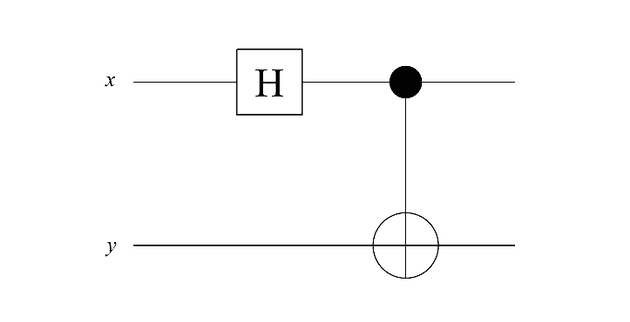
A Hadamard gate (symbolized by the box with an H), applied to the qubit x, puts the qubit x in an equal superposition, or chance that the state is either |0> or |1>.
Subsequently, a CNOT gate (symbolized by the black dot connected to a target circle), set to control qubit x and applied to qubit y, changes the state of qubit y to match the state of qubit x. This demonstrates that the state of qubit y is correlated with qubit x.
Key takeaways in testing the AI tools
1. IBM Qiskit is the default software development stack.
Conductor Quantum Coda, Claude, and Gemini returned the same Python code using the Qiskit SDK for a Bell state preparation circuit, while ChatGPT and Qiskit Code Assistant returned a different variation of Qiskit.
Qiskit is an IBM software development kit (SDK) that enables developers to write quantum circuits in Python. Qiskit is the most widely used quantum software development platform, with nearly 70 percent of open-source quantum developers using it, making it an obvious choice for AI tools.
Conductor Quantum Coda offered an option to select code that integrates with other popular SDKs and frameworks, including NVIDIA CUDA-Q, Amazon Braket, Google Cirq, PennyLane, Rigetti PyQuil, and OpenQASM 3.0. Other AI tools default to Qiskit with no toggle options.
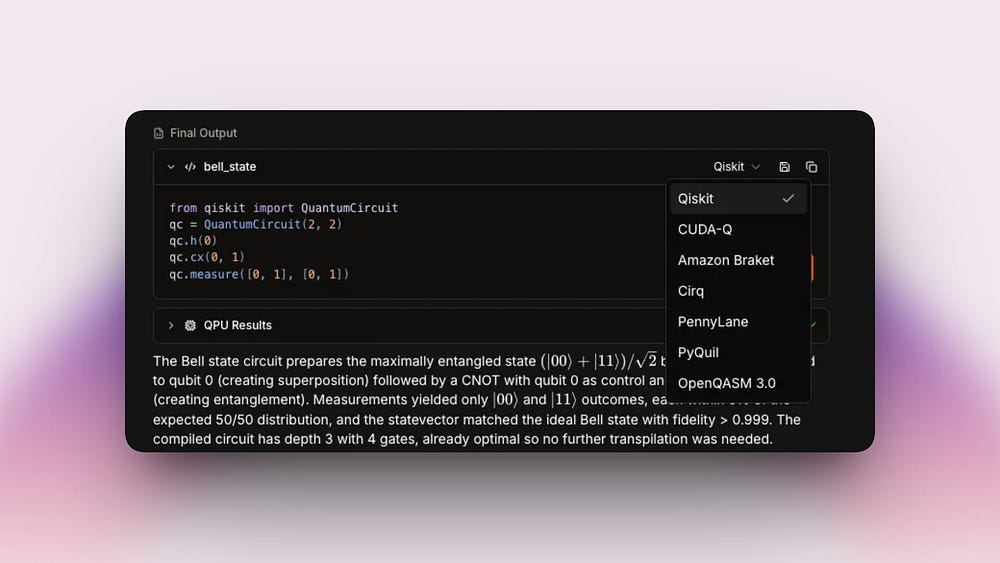
2. (Somewhat) code standardization
Given the circuit’s simplicity, it was expected that code within the same framework would be similar.
The Python code using the Qiskit SDK that most AI tools returned was:
from qiskit import QuantumCircuit

qc = QuantumCircuit(2, 2)
qc.h(0)
qc.cx(0, 1)
qc.measure([0, 1], [0, 1])
qc = QuantumCircuit(2, 2) — creates a quantum circuit with two qubits and two classical bits used for state measurement
qc.h(0) — applies a Hadamard gate on the first qubit
qc.cx — applies a CNOT gate to the second qubit depending on the first qubit’s state, meaning the first qubit acts as the control and the second as the target.
qc.measure([0,1,[0,1]) — measures the current state of the qubit.
ChatGPT returned correct, but slightly different Python code:
from qiskit import QuantumCircuit

qc = QuantumCircuit(2)

qc.h(0)
qc.cx(0, 1)

qc.draw(”mpl”)
The key differences from the ChatGPT version were that it eliminated the two classical qubits used for measurement and displayed a circuit diagram instead of performing a measurement.
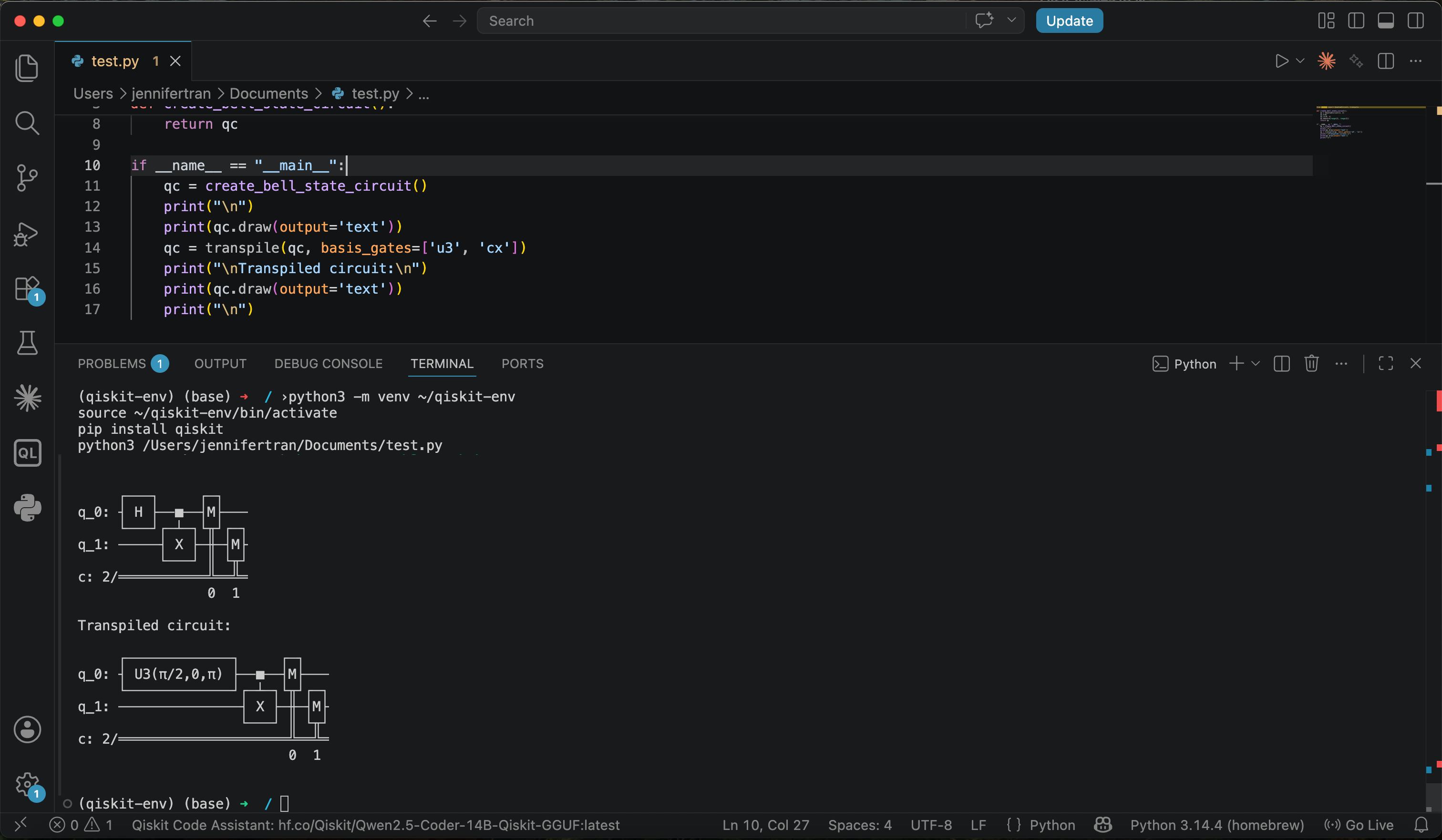
Qiskit Code Assistant, the AI agent developed directly by IBM, combined both approaches and took it a step further by optimizing it for quantum hardware.
qc = transpile(qc, basis_gates=[’u3’, ‘cx’]) — The transpilation process rewrites an input circuit to optimize it for a specific quantum device, because not all quantum computers support all gates. This particular line converts the circuit into another that uses a U3 gate, a generic single-qubit rotation with three Euler angles, instead of a Hadamard gate. However, it appears the local version of Code Assistant I have access to is outdated, as the U3 gate has already been deprecated.
from qiskit import QuantumCircuit, transpile

def create_bell_state_circuit():
    qc = QuantumCircuit(2, 2)
    qc.h(0)
    qc.cx(0, 1)
    qc.measure(range(2), range(2))
    return qc

if __name__ == “__main__”:
    qc = create_bell_state_circuit()
    print(qc.draw(output=’text’))
    qc = transpile(qc, basis_gates=[’u3’, ‘cx’])
    print(”\nTranspiled circuit:\n”)
    print(qc.draw(output=’text’))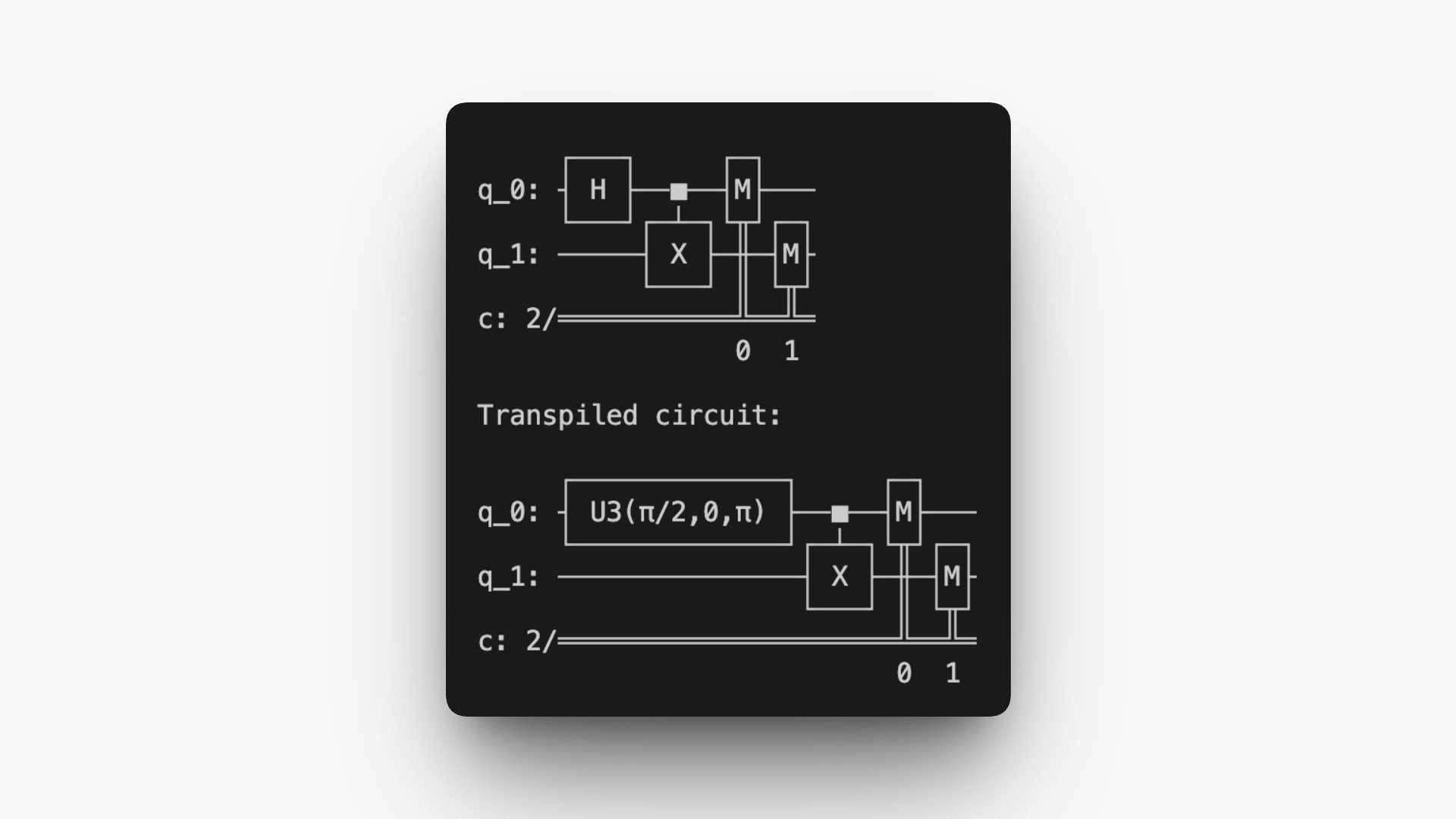
3. Only Coda supports running directly on a quantum computer.
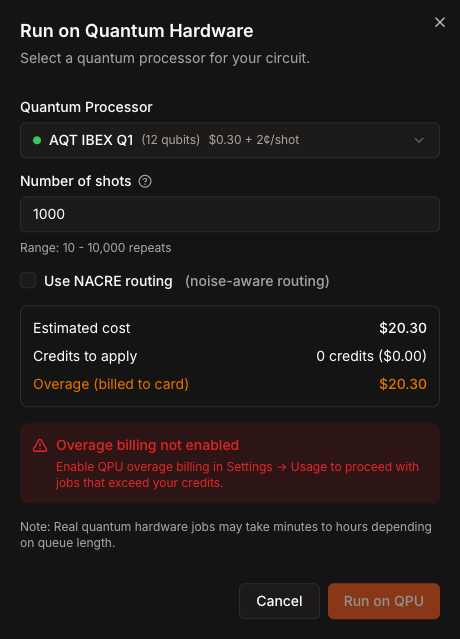
Conductor Quantum Coda was the only tool that supported in-app deployment of a circuit to a cloud service that connected to a quantum computer. This feature simplified the process by removing the need to create, upload, and run a program file as a workflow on a quantum cloud platform.
Coda was the only tool that estimated the number of resources needed, including qubits, depth (the number of times steps, or the time it takes to execute one gate, needed to execute all gates in a quantum circuit), and gates (the number of operations).
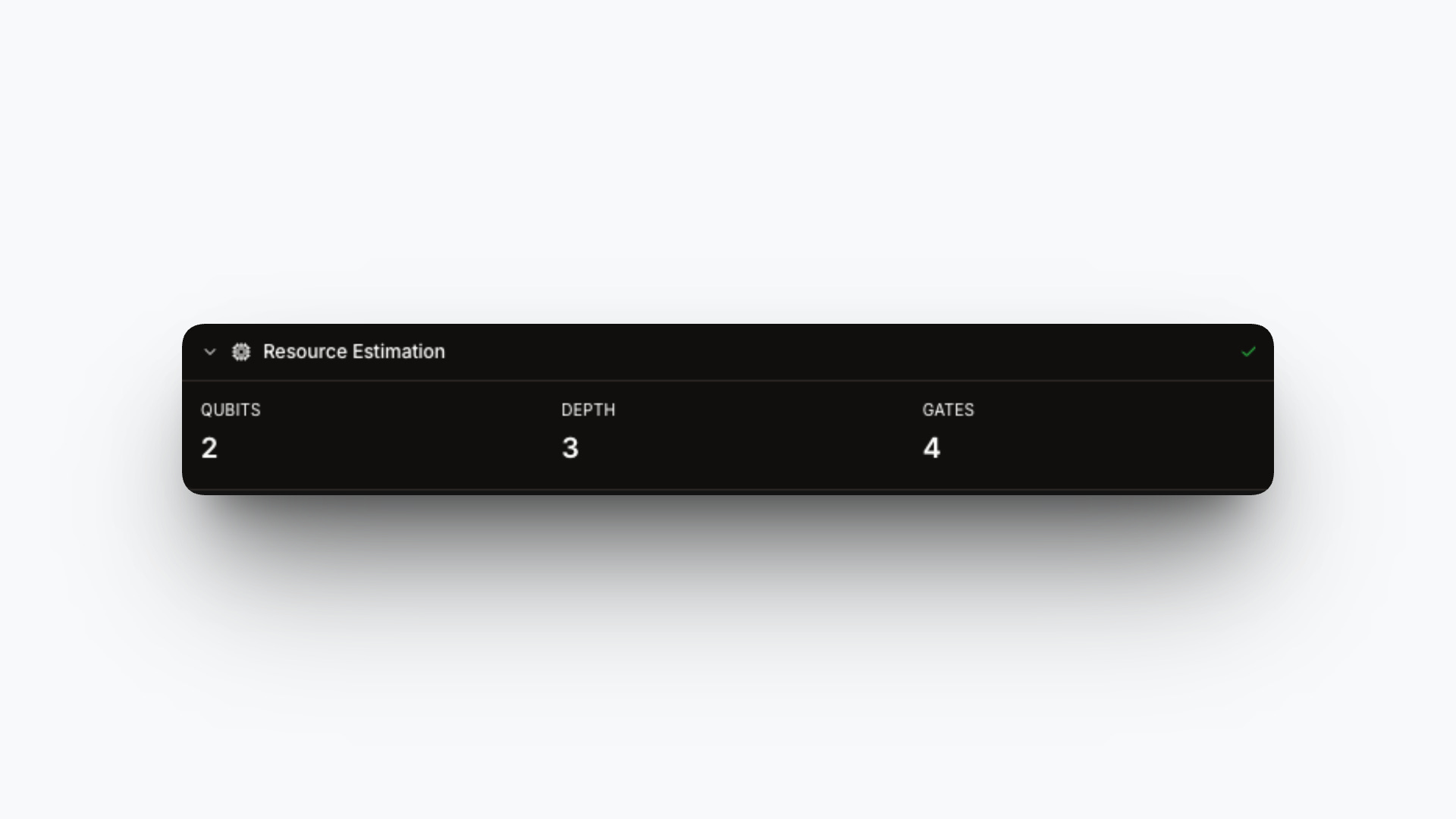
Despite this, it did not recognize that the circuit was small enough to avoid the need for expensive quantum hardware, and the result could have easily been simulated on a classical computer.
It recommended the default quantum hardware to me (AQT IBEX Q1). I was not going to pay $20.30 to run a simple circuit that I could on a classical computer!
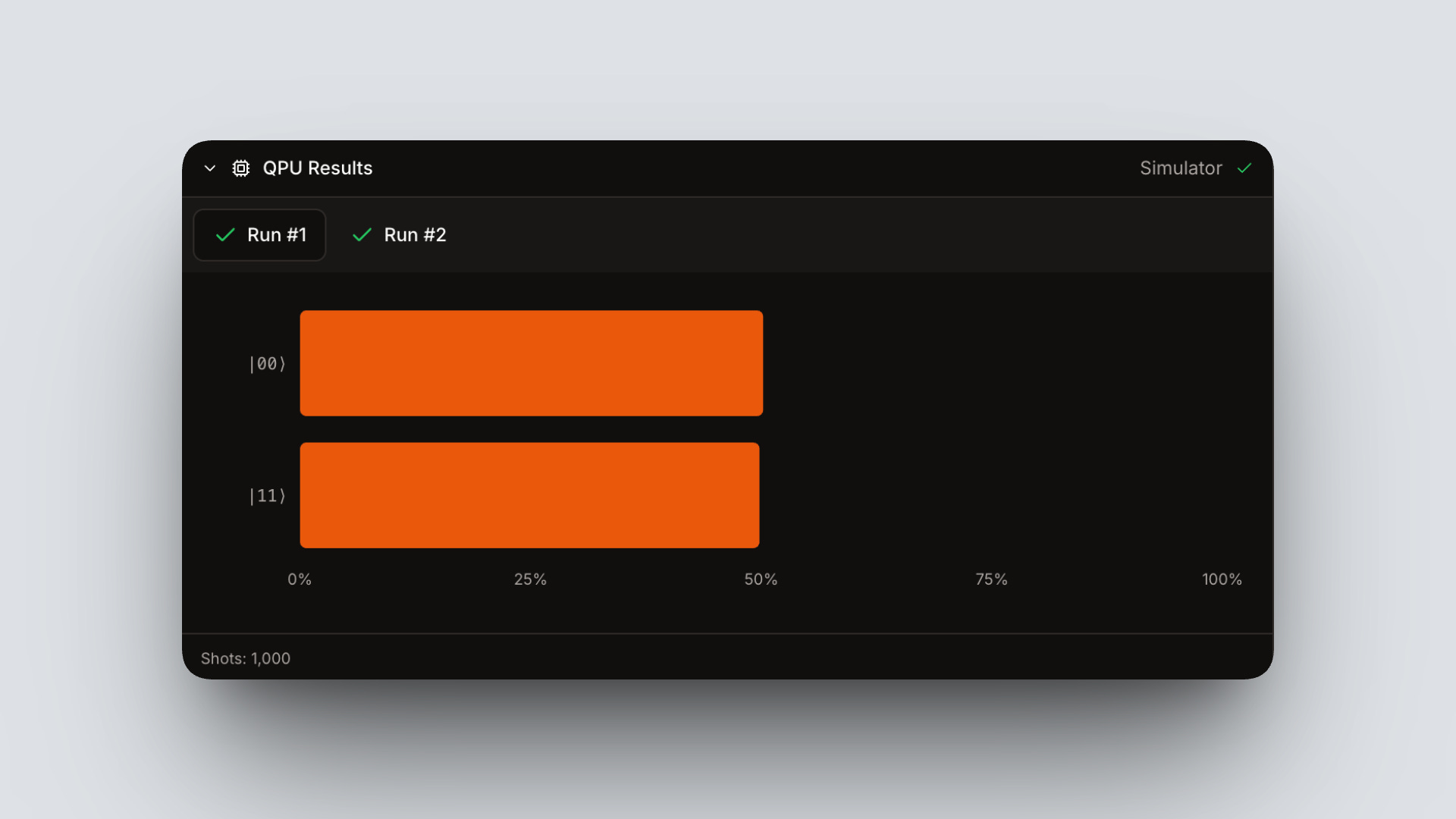
And, I did run the AI-generated circuit on their built-in classical simulator for free, which was more than sufficient. The circuit state has a 50% chance of being |00> or |11>.
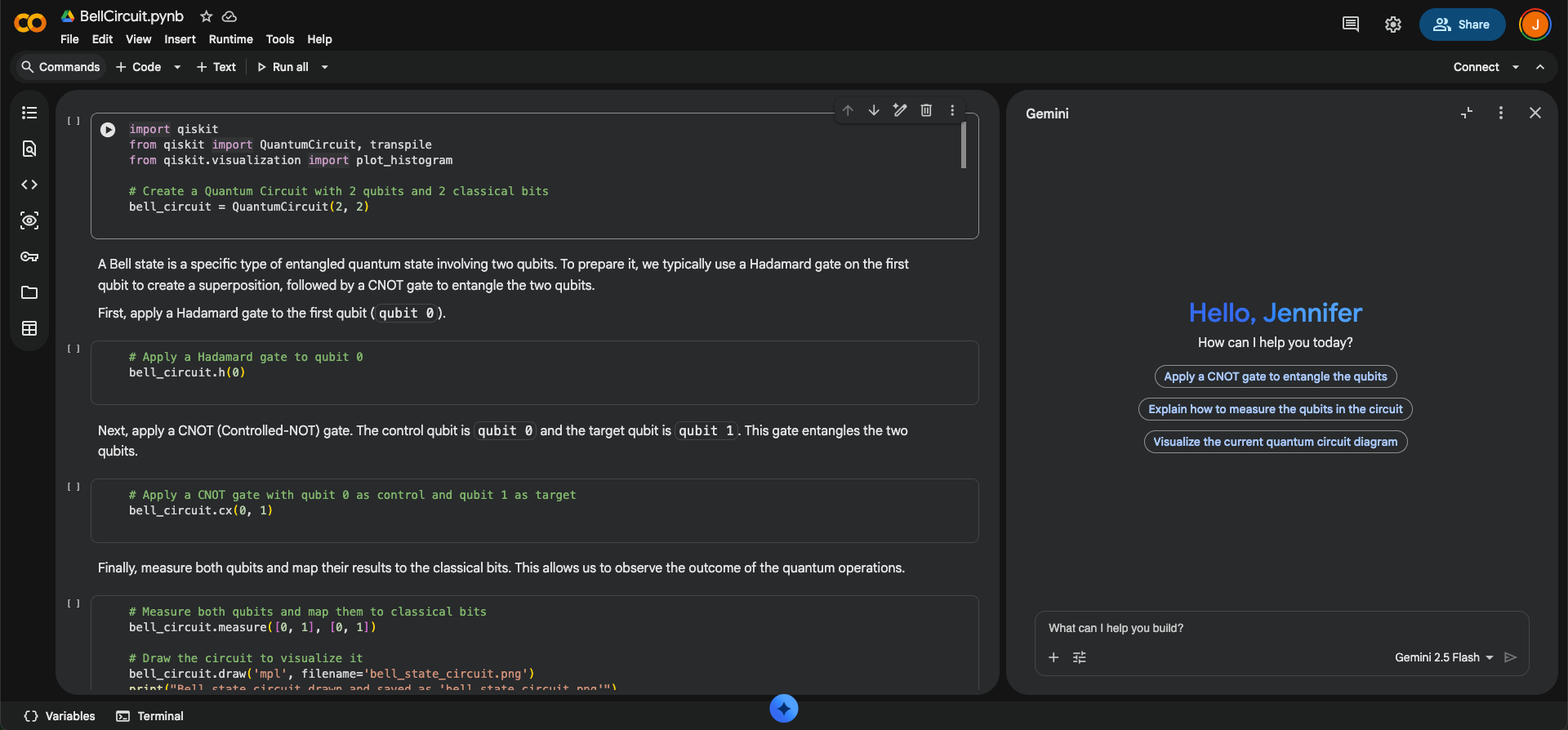
Although they do not support direct deployment, Gemini and Qiskit Code Assistant were not merely chat interfaces and could be used directly in code editors. This allows for easy code editing while utilizing AI.
I used Gemini while writing Python code in a Google Colab notebook.
I loaded Qiskit Code Assistant while writing Python code in the Visual Studio Code desktop editor.
4. (Wide) range of explanations of code and concepts.
The vast differences were found in the explanations of the code and the concept of a Bell state and a Bell state preparation circuit.
Claude and Conductor Quantum Coda provided extensive written explanations of their Bell state preparation circuits, while Gemini and ChatGPT were more succinct. Qiskit Code Assistant did not provide any written explanation; only diagrams of the circuits shown in Point 2 above were provided. Only ChatGPT, Claude, and Qiskit Code Assistant provided circuit diagrams.
For example, ChatGPT provided a simple line and text drawing of a Bell State preparation circuit.
|0⟩ ── H ──■──
           │
|0⟩ ───────X──
While Claude provided a more in-depth visualization using linear algebra.
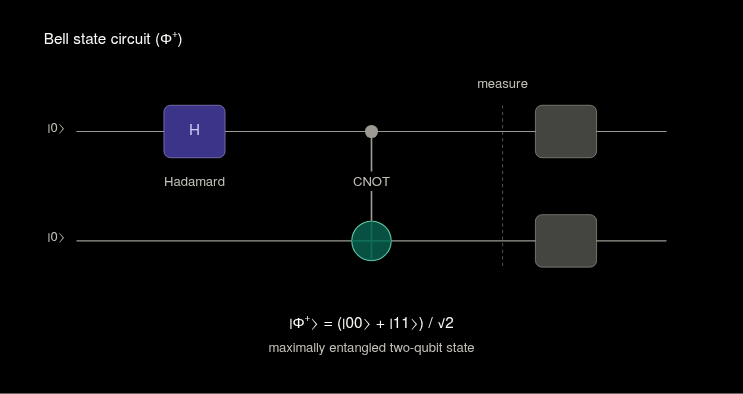
Claude describes the diagram as:
Start with both qubits in |0⟩. Apply a Hadamard gate to qubit 0, which puts it into an equal superposition: H|0⟩ = (|0⟩ + |1⟩)/√2. The two-qubit state becomes (|00⟩ + |10⟩)/√2.
Then apply a CNOT with qubit 0 as control and qubit 1 as target. CNOT flips the target whenever the control is |1⟩, so |00⟩ stays |00⟩ and |10⟩ becomes |11⟩. The final state is (|00⟩ + |11⟩)/√2 — the Φ⁺ Bell state.
My recommendation
For simple circuits for educational purposes:
Conductor Quantum Coda is the most quantum-native AI tool, but it may be too advanced for beginner quantum developers who are not yet prepared to deploy or run programs on a quantum computer.
Gemini and Qiskit Code Assistant are valuable tools for developers who want to edit code while using AI as they write.
Other general-purpose AI tools, like Claude and ChatGPT, are designed mainly for chat interactions, where the user is interested in exploring quantum programming and visualizations, but does not plan to modify or eventually run the code.
In future parts, I’ll analyze the results with more intermediate and advanced circuit requests. I hypothesize that a clearer distinction between code and responses will emerge for more ambiguous algorithm requests.